About Jerome
A one-minute speech
In 2025, at Grace Orchard School, a student stood before twenty classmates and delivered a one-minute speech. I had watched them prepare for months: shaping each sentence, rehearsing it, learning to speak in a room that had not always expected them to be heard.
The applause was brief; the assumption it unsettled was not. For years, how this student learned and processed information had been read as evidence of what they could not do.
I left with a question that has followed me since. When someone cannot explain a need, navigate an institution or be understood on their own terms, what disappears with it?
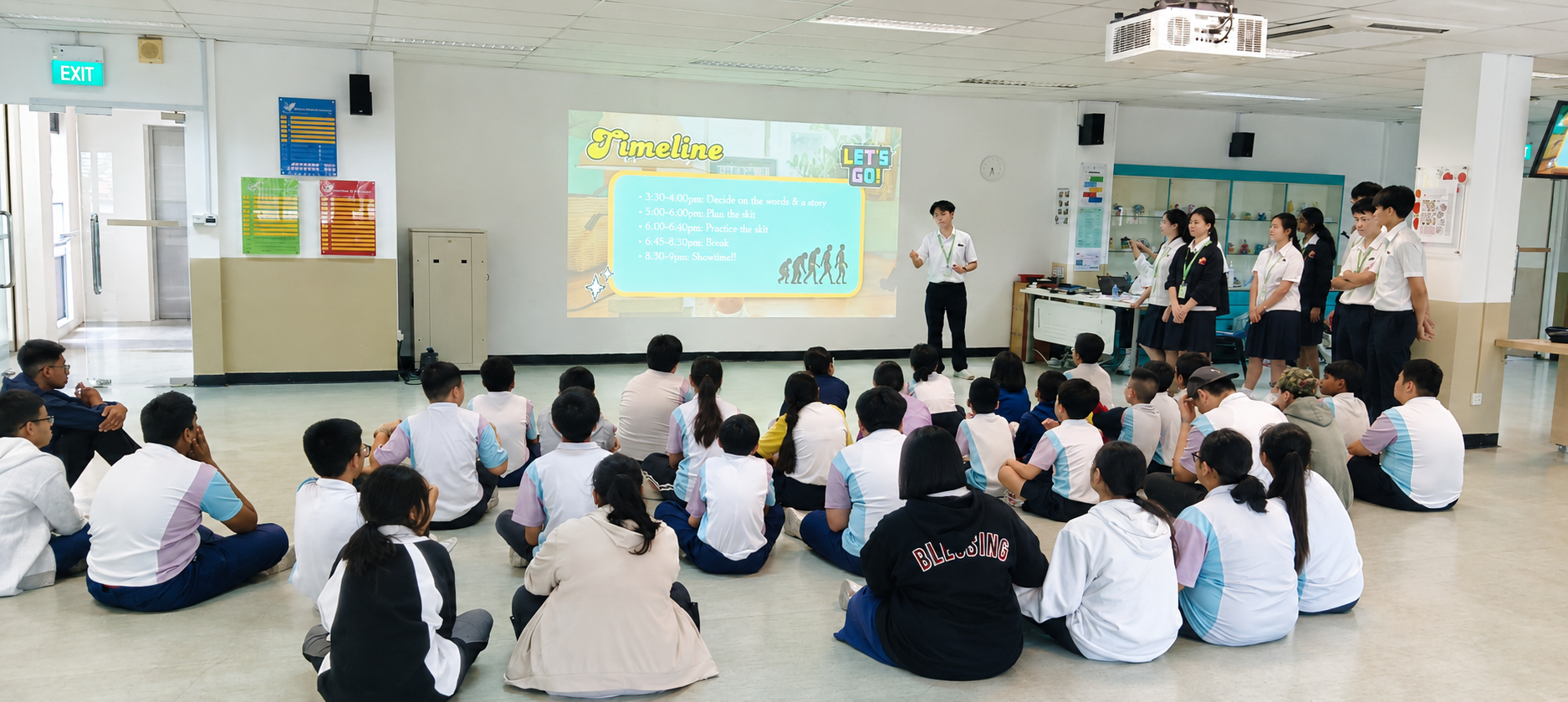
A Project Flare workshop in the months before the speech. Grace Orchard School, 2025.
How I learned to listen
I grew up in a multi-generational household. My parents and I speak English, but with my grandparents, small daily exchanges run in a mix of Mandarin, Hokkien and Singlish: stories, instructions, teasing and the conversations that made family life feel continuous. I spent much of that life in conversation with adults. I learned early that being understood depends on more than speaking fluently. It requires knowing when to ask, when to listen and how to make room for a perspective unlike your own. What I liked was being asked what I thought, at a table where I was the only child.
I still like it best when someone answers a question in a way I did not expect. That is why I keep putting myself in rooms where I am the least experienced person present. My grandfather does this naturally: he answers a question, then returns to it twenty minutes later with what he has really been thinking.
Watching my parents run their business showed me the same thing at a different scale. Their conversations shifted across ages, backgrounds and professional settings, and I began to notice the unspoken work underneath: reading a room, respecting an audience and recognising that the same words carry different weight depending on who receives them.
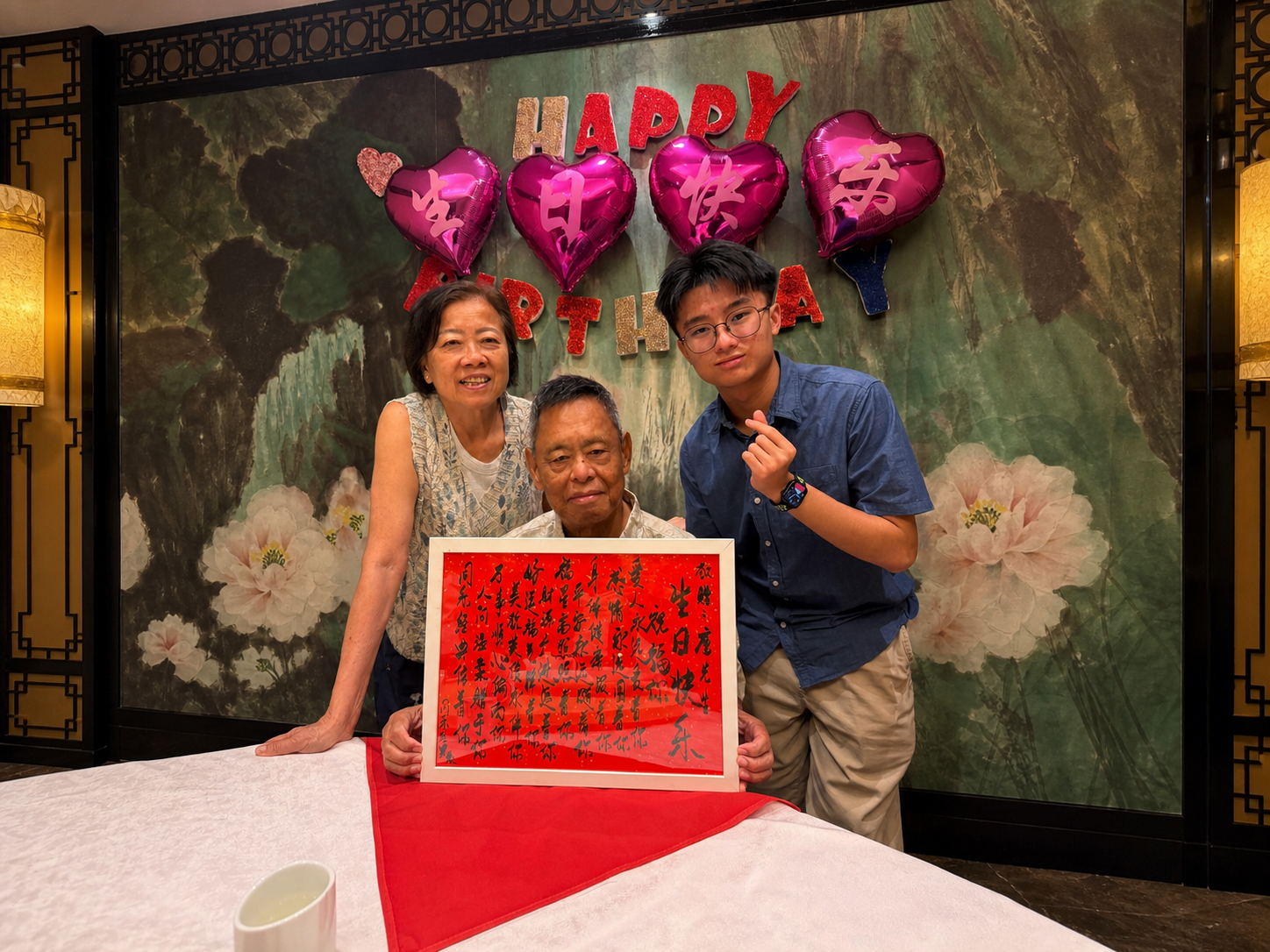
My grandfather’s 78th birthday, 2025. The calligraphy carries wishes for a long life, good health and happiness.
Growing up in Singapore, I became used to things working. Public transport arriving reliably, school information being clear, adults around me knowing where to go when something needed solving. I assumed that if support existed, people could reach it. I did not think about the steps in between: reading a form, knowing whom to ask, having the time or the mobile data, feeling confident enough to say what was wrong.
That assumption did not break all at once. It came apart slowly, in the places I chose to spend time, until I noticed the same thing happening in rooms that had nothing to do with each other. I used to think fairness meant offering everyone the same route. Now I ask who can actually get on it.
What I took for granted
Noticing the pattern
I did not take on these four things because they were connected. The Unspoken Policy is the name I gave the work once the same barrier turned up in all four: an unwritten rule about who is expected to be able to explain themselves.
At Meet-the-People Sessions, a resident could be eligible for support and still struggle to explain a problem in the language or terms a system required. At Project Flare, students had the ideas and rarely the practice of saying them in the form a school or a workplace expects. Through Project Reperio, students could not open a free lesson without reliable mobile data. In Cambodia, English was treated as the way out of the village economy, and six days was not long enough to see how much of it anyone got.
The work itself showed me part of this. Casework did, and so did leading a team that drafted a bill under practising lawyers. I became more interested in the decisions behind these experiences: who designs the form, sets the requirements, funds the service or decides what counts as a problem worth addressing.
The volunteers who had never worked with neurodiverse students asked questions I had stopped thinking to ask. Would the activity actually be understood? What would a student make of an instruction I had written months earlier? A good part of what we changed came from those questions. I have learned to let feedback change the plan rather than fit around it.
I still care about helping someone through the barrier in front of them. I have become more interested in why the barrier is there.
Project Flare →
Communication workshops that make formal self-advocacy explicit.
Meet-the-People Sessions →
Weekly casework in Singapore, roughly half of it in Mandarin.
Project Reperio →
Refugee education and what a free lesson is worth without data.
Overseas service →
Six days in a Khmer village, and what the fundraising total did not show.
Business, law and policy in practice
I did not experience these as separate internships. Together, they became one education in how institutions decide: who gets capital and on what terms, how law makes commitment binding and how a plan survives contact with those who carry it out. Each sharpened the questions I now bring to policy.
WestCap
OBSERVED
Across remote diligence and a visit to the New York office, investment decisions depended on judgements about credibility, growth and risk, factors that rarely sit neatly within a model.
QUESTION IT RAISED
Who receives capital, and whose risks are systematically misread?
Allen & Gledhill
OBSERVED
Across two placements, the second spanning M&A and litigation, no clause was there by accident: each one is a decision about who carries a risk.
QUESTION IT RAISED
How do legal systems distribute access, responsibility and power?
Bain & Company
OBSERVED
Across a live client engagement I supported, complex problems became manageable once their assumptions, stakeholders and sequence were made explicit.
QUESTION IT RAISED
How can social programmes be designed to scale without losing sight of whom they serve?
What these added up to
What these placements had in common was a question about durability: not whether something works, but whether it keeps working once the people who started it are gone. At the GIC-MOE Economics Experience, I heard national reserves described as intergenerational commitments: decisions one generation makes about what the next will be able to do. Project Flare is a much smaller version of the same problem. Sustainability is not only a funding question; it also requires purpose, incentives and accountability to stay aligned as an institution grows. Knowing that is not the same as knowing how to build it, which is what Building sustainable models is about.
What I want to work on
Teaching someone to speak up is only part of making sure they can be heard. Someone still has to fund an interpreter, a redesigned form and the time a caseworker needs to hear a problem twice. None of that survives on goodwill alone. Working out how those costs should be shared between business and government, and whether the answer travels across Southeast Asia or has to be rebuilt in each country, is what I want to spend the next few years on.
I read every message that comes through here. If you work on communication access, run a programme that has hit the durability problem, or have a question about anything on this site, this reaches me directly.