MANDARIN, SINGAPORE AND GREATER CHINA
Language & Region
The language I work in
Mandarin is how I listen, translate and write in the public systems closest to home. It reached me before I could read it: my grandparents' house first, then the hawker centre, now a room where residents come to explain a problem to their Member of Parliament.
What follows is not evidence that I speak it. It is what speaking it gets me into.
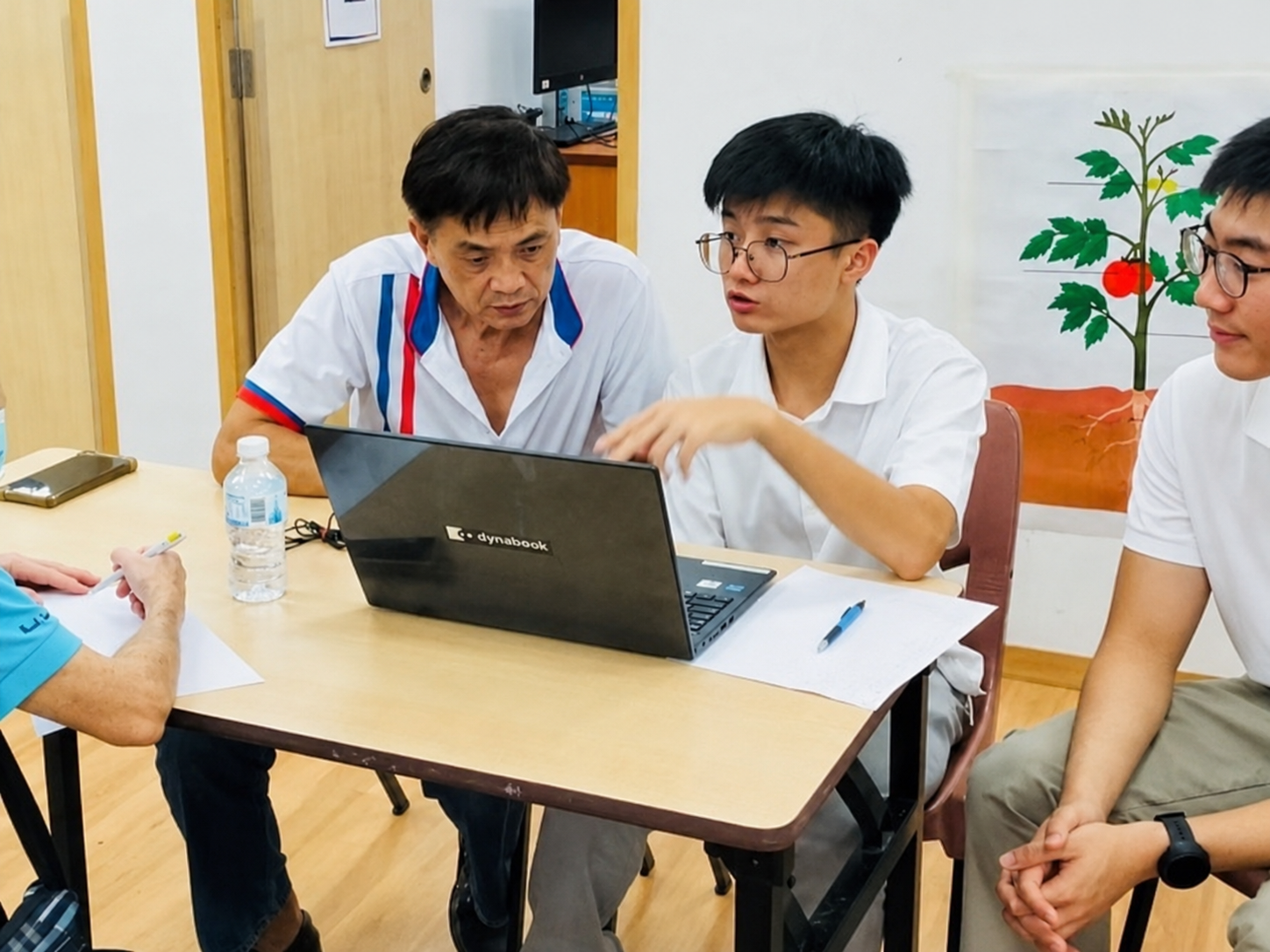
Writing up a case in English after hearing it in Mandarin. Telok Blangah, 2025.
Where the register changes
Mandarin at a hawker centre is rarely textbook Mandarin. It runs through Singlish and dialect, half a sentence at a time, and nobody minds because nobody is being assessed. At the constituency table it tightens. Not into business Chinese, which would sound like the wrong room, but into something slower and more careful.
Learning to move between the two is much of what growing up here taught me about the language. The words barely change. What changes is how much is at stake in being understood the first time.
Where Mandarin meets the record
Roughly half the cases I take are in Mandarin. All of them are written up in English.
A resident explains a housing problem in the Mandarin they use at home, out of order, with what worries them most arriving last. I ask until I have the sequence. Then it becomes a case an officer can act on: dated, ordered, in English. The worry does not make it in.
What arrives at the agency is accurate. It is not what was said.
Often the resident cannot read the English version back.
Most of it is knowing what not to ask directly, and how long to wait. An older resident may not put the problem first; sometimes it is the fourth thing mentioned. Getting there too quickly means getting the wrong one.
From spoken concern to written case
What I could not hear from home
Six days in Shanghai and Nanjing, November 2025, on the Humanities Overseas Enrichment Programme. We researched the sites before we visited them and argued about them afterwards. The week around it ran mostly in Mandarin.
Six days was not long enough to transform my Mandarin. It was long enough to hear it from the outside: the borrowed words, the shortcuts, the places where we reach for English without noticing we have. I had thought Mandarin was the language I shared with a billion people. It is closer to the truth to say that the way I speak it shows where I am from.
What I kept noticing was the distance between the official account of a place and the questions a room of students would ask about it. Not because the official account was false, but because someone had decided which version to present, and to whom. Arguing about that with students shaped by different political contexts is harder than it sounds; I am not sure I did it well every time.
I had gone to look at how another country tells its own story. I came home wondering how mine tells its own.
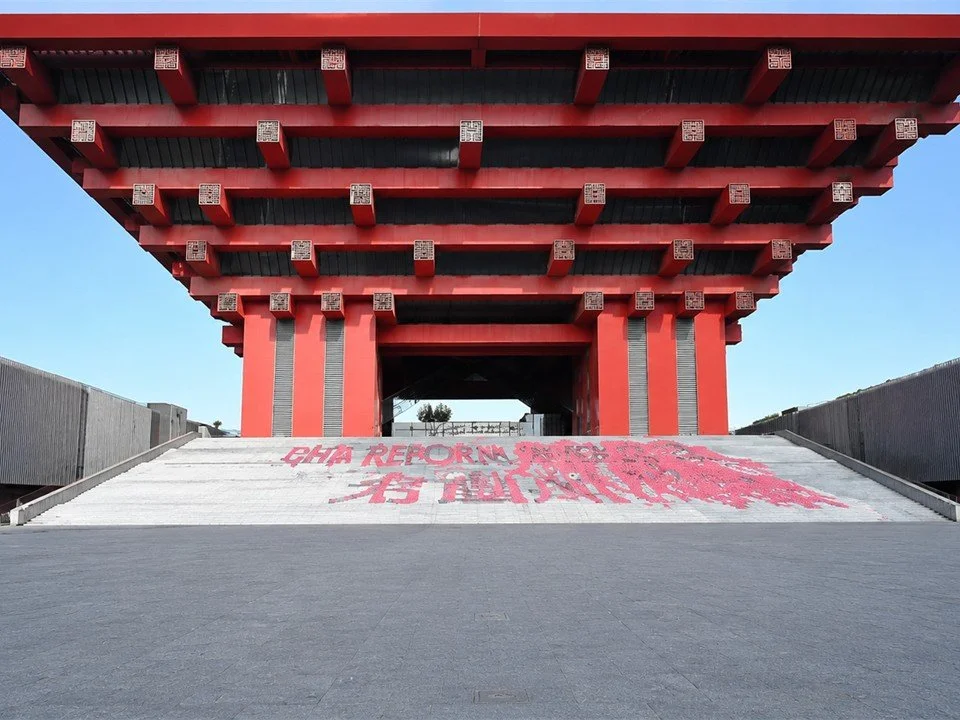
China Art Museum, Shanghai. Humanities Overseas Enrichment Programme, November 2025.
Before the trade figures
On 28 July 2026, I co-moderated a dialogue with Mr George Yeo at my school on the Singapore-China relationship, in front of about a hundred people.
Most writing on the subject begins with trade volumes and supply chains. He began with language, tradition and a longer cultural and historical inheritance between the two countries. The economics did not disappear; it became part of something older.
Then the questions got harder. Whether Singapore can credibly hold a neutral position on AI. What it would mean to buy defence equipment from China. How a small state moves between two larger ones. He did not offer clean answers.
Eight months earlier, in Shanghai and Nanjing, I had been thinking about how a government chooses which version of its history to tell its own people. I had not thought about the other direction: that a shared history also sets what two states expect of each other before anyone sits down.
You can hold the microphone and still not have a question worth asking.
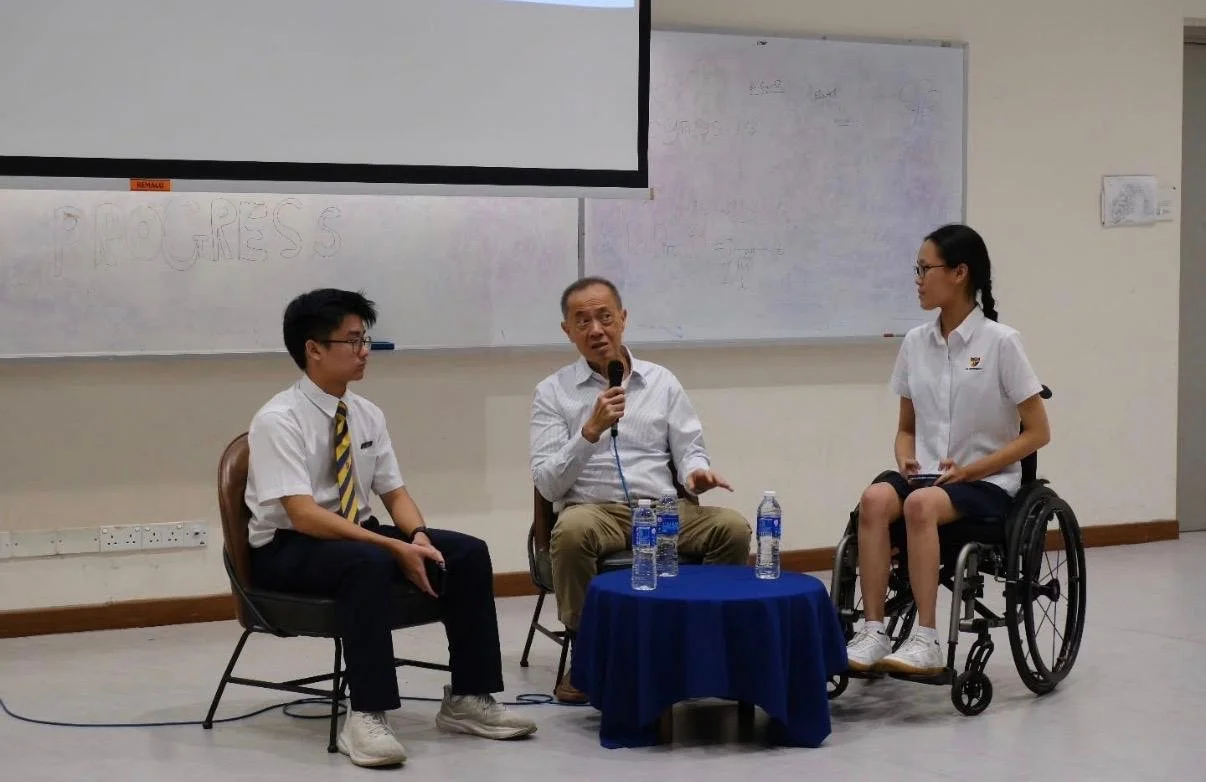
Co-moderating a dialogue with Mr George Yeo on Singapore-China relations. ACS(I), 28 July 2026.
What breaks in translation
Some of my policy pieces were drafted in English and then rewritten in Mandarin. Rewriting is harder than translating. Some arguments survive the move. Some do not. What breaks tells you what the argument was really resting on, and how much of it was being carried by English habits rather than by the idea.
About Them, Without Them《事关他们,却没有他们》
When Australia banned under-16s from social media, I expected to disagree with it. I am not far off the age it targets. What stayed with me was not the ban but the question of who decided. The Gen Z protests in Indonesia and Nepal in 2025 began on the platforms being restricted, and Malaysia is now drafting its own version. The piece is about how being spoken for gets mistaken for being served.
最懂这些空间的年轻人,反而往往是最后才被想到要问的。
The people who know these spaces best are the last anyone thinks to ask.
The Permanent Record《永久记录》
Before applying to university, I was told to clean up my social media. There was almost nothing to clean, and that turned out to be the interesting part. Older generations were allowed to forget and to be forgotten. In Singapore, the Personal Data Protection Act applies primarily to private-sector organisations, while government data is governed under a separate framework. The records that follow you longest sit on the public side. A child's data is logged long before they understand consent.
甩掉过去,正在变成一种“有能力”和“没能力”的差别。
Leaving your past behind is turning into a question of who can afford to.
Two coursework pieces from my early years of secondary school, spoken entirely in Mandarin.
新加坡必游景点
Top attractions to explore in Singapore
发现娘惹文化的丰富遗产
Discovering the rich heritage of Peranakan culture
What I want to find out
Mandarin has made me alert to the distance between what a policy intends and what a person can actually use. I want to know how that distance changes across the region, now that services, schooling and work are moving online.
Does a service offered in four languages actually work in four languages, or does the form still use vocabulary nobody speaks and the helpline still answer in English?
When a platform crosses a border into Malaysia or Indonesia, what does a company have to understand about how people there communicate before it works?
Is the Chinese spoken across Southeast Asia one bridge or several, and what does that mean for anything built to cross it?
For the record
I am now working towards DELE A2. I want to know whether what Mandarin taught me about the distance between a policy and a person holds in a language I learned deliberately rather than one I grew up inside.